FAQ Breeding TonkineseAlthough the policies mentioned here relate to Tonks bred and registered with the GCCF (UK) all registration authorities have similar requirements, so before you start breeding be sure to find out what they are - unless you plan to be a back street breeder.
This page covers - Can I be a Tonkinese breeder? coming soon Essential Policies Tonkinese Breed Numbers/Codes What Is Meant By Active & Non-Active Registers? Is the Generation Of My Tonkinese Important? What do the different GCCF registers mean? Part 2 coming soon will cover - Can I breed from my Tonkinese female? Can I breed from my Tonkinese male? How can I tell what colours will my kittens be? Where can I find more Tonkinese breeders? |
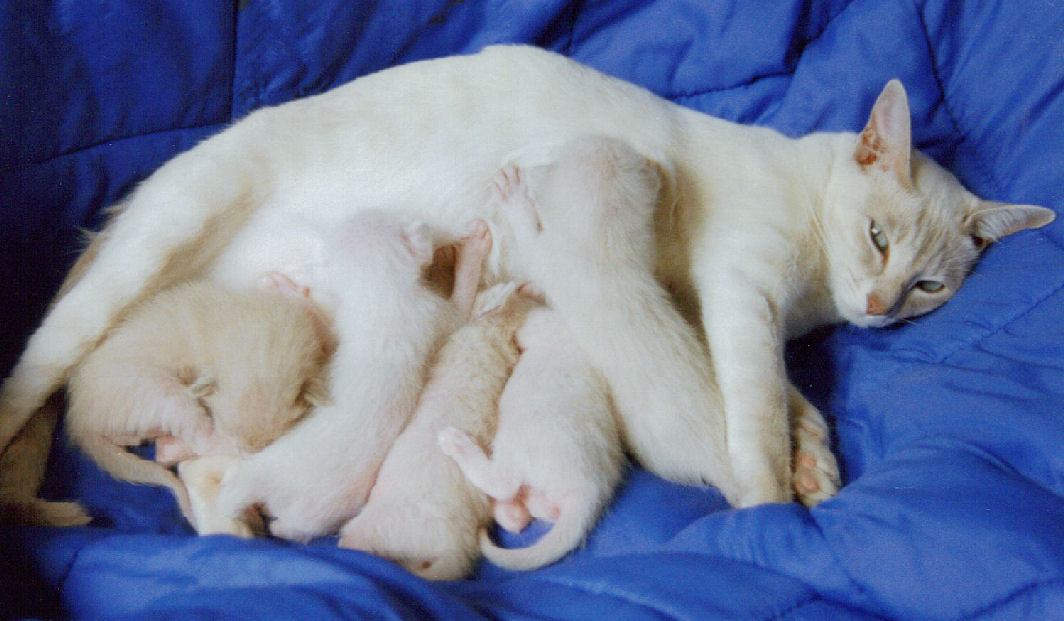
Mymystic Pagan and kittens - © Linda Vousden
|
Can I Be A Tonkinese Breeder?
Well the simple answer is Yes - but there are a great many things to consider and be sure of including (like it or not) your age, health, finances, time, space, energy, support system, temperament and so on - but lets start with small steps and begin with "should I breed from my cat". Here is a short guide to help you ask yourself the right questions - it will open up in a new page.
If you are certain that you have a suitable cat then before you go any further you should address the other points I've mentioned.
Well the simple answer is Yes - but there are a great many things to consider and be sure of including (like it or not) your age, health, finances, time, space, energy, support system, temperament and so on - but lets start with small steps and begin with "should I breed from my cat". Here is a short guide to help you ask yourself the right questions - it will open up in a new page.
If you are certain that you have a suitable cat then before you go any further you should address the other points I've mentioned.
Essential Policies
In the UK the Tonkinese Breed Advisory Committee, working with the Tonkinese Breed Club and the Tonkinese Cat Club, produce the guidelines and policies governing the correct breeding of Tonkinese registered with the GCCF. If you intend to breed Tonkinese it is vital to read the following policies before you start (especially the Breeding Policy), in order to avoid unfortunate and often expensive mistakes.
You'll find them in the FAQ Part 3 drop-down menu.
In the UK the Tonkinese Breed Advisory Committee, working with the Tonkinese Breed Club and the Tonkinese Cat Club, produce the guidelines and policies governing the correct breeding of Tonkinese registered with the GCCF. If you intend to breed Tonkinese it is vital to read the following policies before you start (especially the Breeding Policy), in order to avoid unfortunate and often expensive mistakes.
You'll find them in the FAQ Part 3 drop-down menu.
1) Tonkinese Breeding Policy - The official blueprint for breeding GCCF registered Tonkinese & indicates the way forward. It is essential that breeders read & understand it. As I wrote both the revised and updated versions on behalf of the TBAC I'd be happy to answer any queries on it.
2) Tonkinese Registration Policy - The Registration policy defines how Tonkinese are registered with the GCCF, according to their lineage - see also my Guide to Understanding the Registration Policy.
3) The GCCF Code of Ethics For Breeders & Owners - This document is relevant to all Breeders & Owners who register and/or show their cats under GCCF Rules. Breeders are required to provide each kitten owner with a copy of the Code.
4) The Tonkinese Breed Standard (aka Standard of Points) - This describes the ideal Tonkinese for the purposes of showing, and sets the standard that breeders should strive to obtain, so breeders should make themselves familiar with the SOP whether they show their Tonkinese or not.
2) Tonkinese Registration Policy - The Registration policy defines how Tonkinese are registered with the GCCF, according to their lineage - see also my Guide to Understanding the Registration Policy.
3) The GCCF Code of Ethics For Breeders & Owners - This document is relevant to all Breeders & Owners who register and/or show their cats under GCCF Rules. Breeders are required to provide each kitten owner with a copy of the Code.
4) The Tonkinese Breed Standard (aka Standard of Points) - This describes the ideal Tonkinese for the purposes of showing, and sets the standard that breeders should strive to obtain, so breeders should make themselves familiar with the SOP whether they show their Tonkinese or not.
Tonkinese, and Other, Acceptable Breed Numbers in the Tonkinese Pedigree - go to Tonkinese EMS Codes page.
What Is Meant By Active and Non-Active Registers?
This relates to pedigree cats registered with the Governing Council of the Cat Fancy (GCCF) in the UK, other authorities have similar conditions and may use the same terms. Breeders register their kittens as proof of their pedigree status, and choose whether or not the kitten may be bred from. Once a kitten is registered the kitten's owner will receive a copy of the registration document - if the kitten is on the Non-Active register it will be clearly stated.
Active - A kitten registered as Active may be bred from and its progeny may be registered with the GCCF.
Non-Active - The kitten may not be bred from. Should the cat have kittens the GCCF will not register them.
Active - A kitten registered as Active may be bred from and its progeny may be registered with the GCCF.
Non-Active - The kitten may not be bred from. Should the cat have kittens the GCCF will not register them.
Is The Generation Of My Tonkinese Important?
ANSWER: - Only if you intend to breed from, or show, your Tonk.
In the USA & Canada Tonkinese have been bred for so long that a five generation pedigree will only show Tonkinese ancestors, so the question is no longer significant. However, the generation becomes significant where the pedigree may include Burmese or Siamese - such as in the UK where we still allow breeding of first generation Tonkinese (F1) to keep our gene pool healthy.
So what generation Tonkinese should I buy?
1) If your kitten has only one Tonkinese parent then it is not a Tonkinese and should not be bred from.
2) If your kitten has both a Burmese and a Siamese parent it is a 1st generation Tonkinese, it may be bred from but cannot be shown.
3) If your Tonkinese kitten's parents are both Tonkinese, but not all of the grand-parents are, your kitten is 2nd generation, it may be bred
from but cannot be shown.
4) If your Tonkinese kitten's parents and grandparents are all Tonkinese, but not all of the great-grandparents are, your kitten is 3rd generation,
it may be bred from but cannot be shown.
5) If your Tonkinese kitten's parents, grandparents and great-grand parents are all Tonkinese then it is 4th generation, it may be bred from and
may be shown.
If you wish to breed from, or show, your Tonkinese then before buying your kitten it is important to understand the Tonkinese Registration Policy (see also my own guide to Understanding the Tonkinese Registration Policy), and the Standard of Points.
In the USA & Canada Tonkinese have been bred for so long that a five generation pedigree will only show Tonkinese ancestors, so the question is no longer significant. However, the generation becomes significant where the pedigree may include Burmese or Siamese - such as in the UK where we still allow breeding of first generation Tonkinese (F1) to keep our gene pool healthy.
So what generation Tonkinese should I buy?
1) If your kitten has only one Tonkinese parent then it is not a Tonkinese and should not be bred from.
2) If your kitten has both a Burmese and a Siamese parent it is a 1st generation Tonkinese, it may be bred from but cannot be shown.
3) If your Tonkinese kitten's parents are both Tonkinese, but not all of the grand-parents are, your kitten is 2nd generation, it may be bred
from but cannot be shown.
4) If your Tonkinese kitten's parents and grandparents are all Tonkinese, but not all of the great-grandparents are, your kitten is 3rd generation,
it may be bred from but cannot be shown.
5) If your Tonkinese kitten's parents, grandparents and great-grand parents are all Tonkinese then it is 4th generation, it may be bred from and
may be shown.
If you wish to breed from, or show, your Tonkinese then before buying your kitten it is important to understand the Tonkinese Registration Policy (see also my own guide to Understanding the Tonkinese Registration Policy), and the Standard of Points.
What Do The Different GCCF Registers Mean?
In the past few years the structure of breed registration under the GCCF has altered, resulting in a less time consuming, and more realistic, process for recognised breeds to progress to Championship status. There are still many cats whose pedigrees show the now redundant registers, and many line chasers who wish to understand them, so I have included all of them below for your information.
When, in 1910, the GCCF took over as the UKs primary register of pedigree cats, they gave the cats an individual identifying number; the number has no relation to breed, gender or coat-pattern/colour. The register grew steadily, but following the end of WW II pedigree cat breeding took off again in a big way and by the end of 1972 the number of cats registered had grown exponentially and was reaching a quarter of a million. A New Series (NS) of numbers started at 000001 again, although the first series of numbers was recorded without letters on the registration documents they are generally referred to as the Original Series (OS).
Unfortunately I don't have clear records of the next stage but it seems that sometime between June 1985 and June 1986 the next series of numbers was filtered in, the Current Series (CS) starting around 010000 - but there does seem to be some to and fro of registering cats with CS and NS numbers until the end of 1986 (if I find more information I will update this). To date we are still using the CS series.
Examples of the GCCF registrations are:
OS 144132, OSSR 054973, NS 231192, SRNS 163007, CS 308737, CSSR 628430, CSEXP 197400 CSREF 393746,
As well as being given a registration number a cat is also placed in a particular register that indicates how it has been bred according to the breed policy of the time. In the examples shown above the SR refers to Supplementary Register; EXP refers to the Experimental Register and REF refers to Reference Registers - these are explained below.
FULL REGISTER - (OS, NS, CS)
SUPPLEMENTARY REGISTER - (OSSR, SRNS, CSSR)
EXPERIMENTAL REGISTER - (CSEXP) - no longer in use
REFERENCE REGISTER - (CSREF)
In the past few years the structure of breed registration under the GCCF has altered, resulting in a less time consuming, and more realistic, process for recognised breeds to progress to Championship status. There are still many cats whose pedigrees show the now redundant registers, and many line chasers who wish to understand them, so I have included all of them below for your information.
When, in 1910, the GCCF took over as the UKs primary register of pedigree cats, they gave the cats an individual identifying number; the number has no relation to breed, gender or coat-pattern/colour. The register grew steadily, but following the end of WW II pedigree cat breeding took off again in a big way and by the end of 1972 the number of cats registered had grown exponentially and was reaching a quarter of a million. A New Series (NS) of numbers started at 000001 again, although the first series of numbers was recorded without letters on the registration documents they are generally referred to as the Original Series (OS).
Unfortunately I don't have clear records of the next stage but it seems that sometime between June 1985 and June 1986 the next series of numbers was filtered in, the Current Series (CS) starting around 010000 - but there does seem to be some to and fro of registering cats with CS and NS numbers until the end of 1986 (if I find more information I will update this). To date we are still using the CS series.
Examples of the GCCF registrations are:
OS 144132, OSSR 054973, NS 231192, SRNS 163007, CS 308737, CSSR 628430, CSEXP 197400 CSREF 393746,
As well as being given a registration number a cat is also placed in a particular register that indicates how it has been bred according to the breed policy of the time. In the examples shown above the SR refers to Supplementary Register; EXP refers to the Experimental Register and REF refers to Reference Registers - these are explained below.
FULL REGISTER - (OS, NS, CS)
SUPPLEMENTARY REGISTER - (OSSR, SRNS, CSSR)
EXPERIMENTAL REGISTER - (CSEXP) - no longer in use
REFERENCE REGISTER - (CSREF)